LipoBliss Ingredients: What's Inside?
A label is only useful if you know what each line means. Here is every core component of the LipoBliss liquid formula, what it is studied to do, and the dose that separates a real effect from a decorative one.
What is inside LipoBliss?
The LipoBliss ingredients are a natural, non-GMO, plant-based blend built around four actives: Garcinia Cambogia for its HCA, green tea extract for EGCG, L-carnitine for fatty-acid transport, and African mango seed. Each targets a different lever, appetite, fat oxidation or fat metabolism, in a once-daily liquid rather than a capsule.
- Garcinia HCA is dosed toward roughly 1,500 mg per day; green tea EGCG toward the studied 270 to 400 mg range.
- African mango seed showed reduced waist and body fat at 150 mg twice daily over 10 weeks.
- Doses on the printed Supplement Facts panel, not the ingredient list length, decide whether it works.
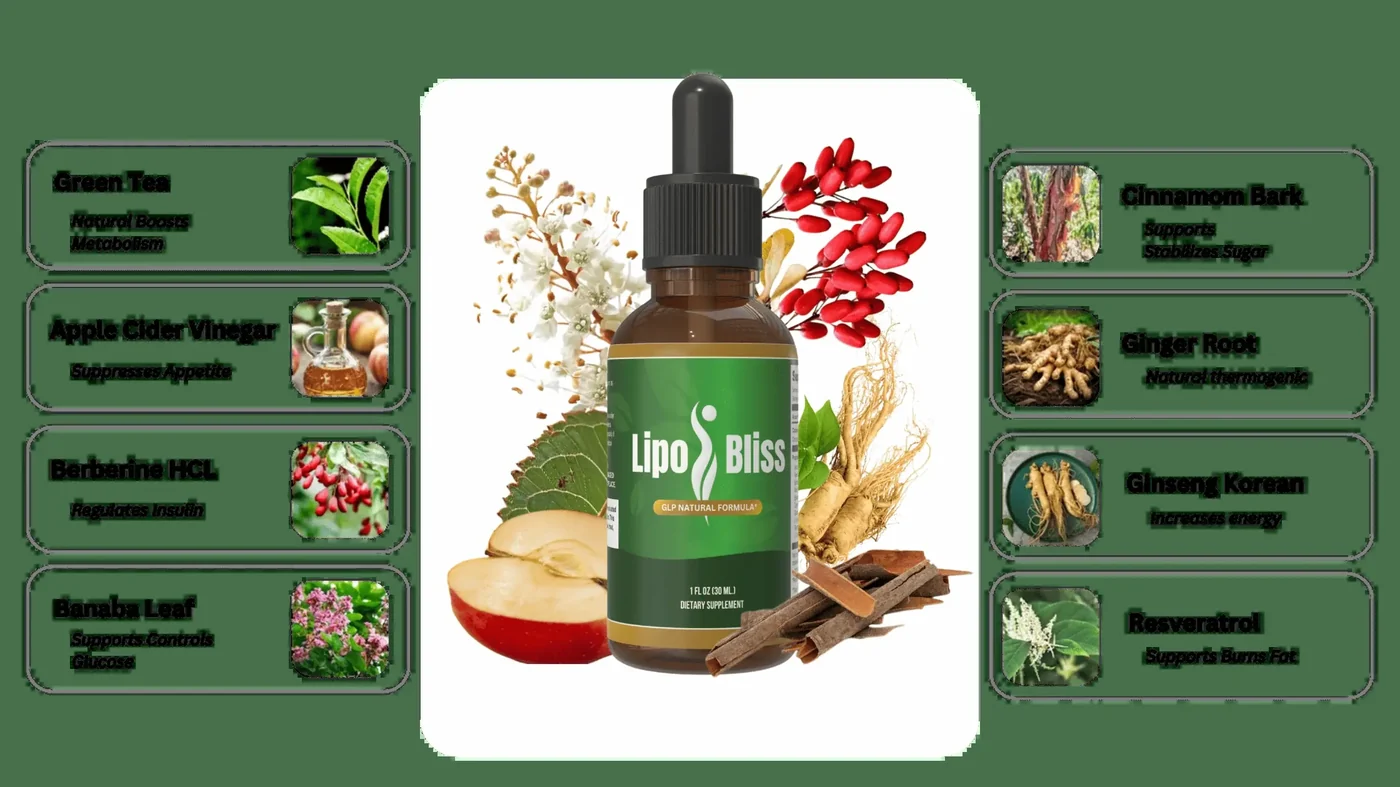
When people ask about the LipoBliss ingredients, they usually want one of two things: reassurance that the formula is not full of mystery fillers, or a genuine understanding of what each component is meant to do. This article is written for the second group. The formula is a natural, non-GMO, plant-based liquid blend, and rather than list the names and move on, we will take the four core actives one at a time, explain the plausible mechanism behind each, and attach the dose that the research actually used. That last part is where most ingredient breakdowns quietly give up, and it is the part that decides whether a blend does anything at all.
One principle frames everything below: a plausible mechanism is a starting point, not a promise. Every ingredient here has a reason it might help. Whether it helps you, at the amount in the bottle, on top of your own diet and activity, is a separate and more modest question. Keep that distinction in mind and the label stops being a wall of marketing and starts being useful information.
Garcinia Cambogia (HCA): the appetite and fat-storage angle
Garcinia Cambogia is a small tropical fruit, and the part that matters is the rind, which is rich in hydroxycitric acid, or HCA. The proposed mechanism is twofold: HCA inhibits an enzyme called ATP-citrate lyase, which the body uses to turn excess carbohydrate into stored fat, and it may modestly influence appetite through serotonin-related pathways. On paper that is an attractive one-two of eating a little less and storing a little less.
The honest evidence picture is mixed. Some trials report small reductions in appetite or body weight, others find no meaningful difference against placebo, and reviews tend to land on a modest and inconsistent effect. Dose is a big part of the story: the studied benefits cluster around roughly 1,500 mg of HCA per day, so a product that under-doses HCA is unlikely to reproduce even the modest trial results. If you want the full evidence picture on this one ingredient, our deep dive into Garcinia Cambogia HCA and the weight-loss evidence lays out the trials without the sales gloss.
Garcinia is the ingredient that made this whole category famous and the one most likely to be under-dosed. The HCA number on the panel tells you far more than the word "Garcinia" on the front of the bottle.
Green tea extract (EGCG): the fat-oxidation workhorse
If any ingredient in the blend has earned its place, it is green tea extract. Its catechins, led by epigallocatechin gallate (EGCG), have been shown in controlled work to modestly raise energy expenditure and fat oxidation, an effect that is amplified by the small amount of caffeine that naturally rides along with them. The studied EGCG doses generally sit in the 270 to 400 mg per day range, which is a realistic target for a serious formula rather than a fantasy number.
The word to hold on to is modest. Green tea nudges the rate at which you burn fuel; it does not override how much fuel you take in. Reviews of green tea for actual weight loss show small average effects that can fade over time, which is exactly what you would expect from a metabolic nudge rather than a metabolic override. Used honestly, it is a legitimate supporting actor. For the mechanism in detail, see our explainer on green tea extract, EGCG and fat metabolism.
L-carnitine: the fatty-acid shuttle
L-carnitine is an amino-acid derivative your body already makes and also gets from meat and dairy. Its job is specific and well understood: it shuttles long-chain fatty acids across the membrane into the mitochondria, the part of the cell where fat is actually burned for energy. Because that transport step is a genuine bottleneck in fat metabolism, the logic of supplementing it is easy to follow.
The evidence is real but measured. Pooled analyses of randomised trials suggest a small average reduction in body weight with L-carnitine supplementation in some groups, and it is generally well tolerated. The mechanism does not, however, mean that more carnitine equals more fat burned in a person who is already replete and eating adequate protein; the transport step is not always the limiting factor. It is a sensible inclusion with a plausible mechanism and modest data, which is a fair way to describe a supporting ingredient. Our review of what the research shows on L-carnitine and fat metabolism covers the nuance.
Want to check the exact doses on the current label?
The Supplement Facts panel is the final word on HCA, EGCG and every other amount. See the current label, pricing and the 60-day guarantee at the official store.
View the Official LabelAfrican mango seed: the most interesting data point
African mango, or Irvingia gabonensis, is the ingredient with the most eye-catching single study behind it. In a well-known trial, participants taking 150 mg of the seed extract twice daily saw reductions in waist circumference and body fat over 10 weeks compared with placebo. The proposed mechanisms involve effects on fat-cell metabolism and on satiety-related signalling, though the overall body of evidence is thinner than the headline result suggests, resting on a small number of studies from overlapping research groups.
Taken at face value, that 150 mg twice-daily figure is the number to look for, and it is a reminder that the timing and split of a dose can matter as much as the total. Taken sceptically, it is a promising signal that needs more independent replication before anyone treats it as settled. Both readings are honest, and a good ingredient breakdown gives you both rather than picking the flattering one.
Non-GMO, plant-based, and the caffeine question
LipoBliss is presented as a natural, non-GMO, plant-based blend, which speaks to the sourcing philosophy: no synthetic actives, no genetically modified inputs, and ingredients drawn from plants rather than a lab. That is a reasonable thing to want, though it is worth saying that "natural" is a description of origin, not a guarantee of effect or of safety, since plenty of potent compounds are perfectly natural.
The one nuance people miss is caffeine. Green tea extract naturally contains a small amount of caffeine unless it has been specifically decaffeinated, so a green-tea-containing formula is better described as low-stimulant than as guaranteed caffeine-free. For most people that trace amount is trivial. For anyone highly caffeine-sensitive, or taking it late in the day, it is worth checking the current label. This is a small point, but it is exactly the kind of thing an honest breakdown flags rather than glosses over.
| Ingredient | Studied role | Dose that matters | Evidence strength |
|---|---|---|---|
| Garcinia Cambogia (HCA) | Appetite, fat storage via ATP-citrate lyase | ~1,500 mg HCA/day | Modest, mixed |
| Green tea extract (EGCG) | Energy expenditure, fat oxidation | 270–400 mg EGCG/day | Modest, replicated |
| L-carnitine | Fatty-acid transport into mitochondria | Commonly 1–2 g/day in trials | Small, real |
| African mango seed | Fat metabolism, satiety signalling | 150 mg twice daily | Promising, needs replication |
Why the LipoBliss ingredients list is not the finished formula
Here is the point that separates a useful breakdown from a flattering one. Evidence for an ingredient at a studied dose is not evidence for a multi-ingredient product. A blend can under-dose its best component to make room for cheaper ones, combine actives that have never been tested together, or deliver them in a form that changes absorption. The only way to judge is to read the Supplement Facts panel and compare the printed amounts against the targets above, particularly the HCA and EGCG figures, which are the two most likely to be quietly trimmed.
That is not a reason for cynicism, it is a reason for literacy. When you can read the panel, a formula stops being a leap of faith and becomes a comparison you can actually make. If you want to see how those doses translate into real-world expectations, our balanced take on whether the drops deliver in the LipoBliss reviews and results breakdown is the natural next read.
Frequently asked questions
What are the main active ingredients in LipoBliss?
The LipoBliss formula is built around four core ingredients: Garcinia Cambogia standardised for hydroxycitric acid (HCA), green tea extract as a source of the catechin EGCG, L-carnitine, and African mango seed. Each is a plant-derived or plant-associated compound with a defined role in appetite, fat oxidation or fat transport, and the drops are presented as a natural, non-GMO, plant-based blend delivered in liquid form.
Is LipoBliss non-GMO and stimulant-free?
LipoBliss is marketed as a natural, non-GMO, plant-based blend, so it avoids synthetic and genetically modified inputs. It is not, however, guaranteed to be entirely stimulant-free: green tea extract naturally carries a small amount of caffeine unless it has been decaffeinated. It is best described as low-stimulant rather than caffeine-free, and anyone highly sensitive to caffeine should check the current label before buying.
How much HCA and EGCG does a serving provide?
The formula is designed around a Garcinia HCA target in the region of 1,500 mg per day and a green tea EGCG amount in the studied 270 to 400 mg per day range, since those are the doses most associated with results in the research. The Supplement Facts panel on the bottle is the authority on the exact per-serving figures, so read it against these targets rather than assuming the maximum studied dose is present.
Are the LipoBliss ingredients backed by studies?
Individually, yes, to varying degrees. Green tea EGCG has controlled data on fat oxidation, L-carnitine has a well-understood role in fatty-acid transport and some pooled weight data, African mango seed showed reductions in waist and body fat at 150 mg twice daily over 10 weeks, and Garcinia HCA has mixed appetite and fat-storage results. Evidence for a single ingredient at a studied dose is not the same as evidence for the finished blend, which is why the label doses matter.
Related reading
References
See the full LipoBliss label and doses
Every ingredient, the amounts you can actually verify, the current sale terms and the 60-day money-back guarantee.
Visit the Official Store