Coleus Forskohlii in LipoBliss: What the Forskolin Trials Actually Dosed, and What a 200mg Blend Can't Tell You
LipoBliss names Coleus Forskohlii Root Extract as one of nine ingredients inside its 200 mg proprietary blend. The published forskolin trials, by contrast, report an exact milligram dose of a standardized extract. Put the two side by side and the honest answer is that you cannot compare them — here is why, and what that means if forskolin is the reason you are looking at this product.
Quick answer
LipoBliss's sales page lists Coleus Forskohlii Root Extract inside a single 200 mg “Proprietary Herbal Blend” of nine named ingredients, with no individual amount printed for it. The clinical trials most often cited for forskolin used a stated daily milligram dose of a standardized extract. Because LipoBliss does not disclose a comparable figure, there is no way to know whether its Coleus forskohlii content is anywhere near what was tested — and the seller's own page does not claim it is.
- LipoBliss's only individually disclosed ingredient amount, anywhere on the page, is chromium picolinate at 7 mcg.
- The classic 2005 forskolin trial used 250 mg of a 10%-standardized extract, twice daily, for 500 mg of extract a day.
- Whether LipoBliss's 200 mg blend total is per 1 mL daily serving or per 30 mL bottle is not stated on the sales page.
Coleus forskohlii shows up on a lot of weight-management labels, usually described in a single confident sentence about “supporting fat breakdown.” What almost never shows up next to that sentence is a number you could actually check against the research. LipoBliss is a useful case study in exactly that gap, because its sales page names Coleus Forskohlii Root Extract plainly, and just as plainly declines to say how much of it is in a bottle.
What Coleus forskohlii is, and why it is in formulas like this one
Coleus forskohlii is a plant in the mint family, native to parts of India, whose root has long been used in Ayurvedic preparations. Modern interest in it centers on forskolin, a labdane diterpene compound extracted from the root that activates an enzyme called adenylate cyclase, which in turn raises levels of cyclic AMP (cAMP) inside cells. Cyclic AMP is a signaling molecule involved in several processes relevant to a weight-management product's marketing story, including lipolysis (the breakdown of stored fat into fatty acids) and thermogenesis. That mechanism is why forskolin extract, standardized to a percentage of forskolin content, turns up in fat-loss and testosterone-support formulas.
The mechanism is real pharmacology, not a fabricated story — forskolin's action on adenylate cyclase is well documented in laboratory research and is in fact why forskolin is used as a standard research tool to raise cAMP in cell studies unrelated to weight loss. The open question, as with most single-ingredient mechanisms, is whether an oral supplement dose in a real person produces enough of that effect to matter, and that is precisely the question dose-ranging human trials exist to answer.
What LipoBliss's own label actually says
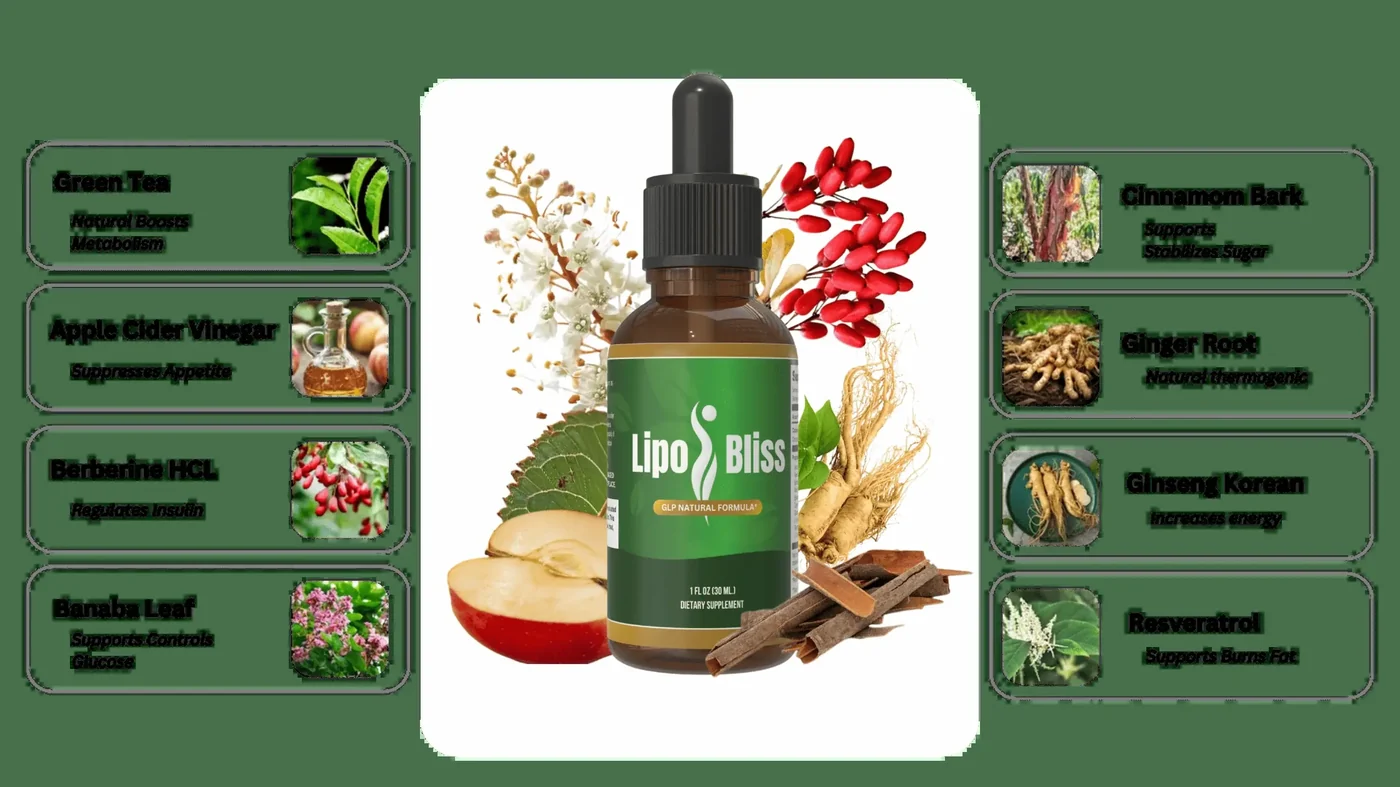
Here is everything the LipoBliss sales page discloses about its formula, transcribed rather than summarized, because the specifics matter more than the marketing language around them. The bottle is a 1 FL OZ (30 mL) dropper bottle labeled “GLP Natural Formula,” with printed directions to take 1 mL (about two droppers) once daily, in the morning or before the largest meal. The page states “30-Day Supply Per Bottle.”
The formula itself is described as a “200mg Proprietary Herbal Blend” of a claimed “21 Botanicals, Aminos & Nutrients,” but the sales-page text only actually names nine of them, in this printed order:
| Ingredient (as printed) | Listed amount |
|---|---|
| Maca Root Extract | Not printed (proprietary blend) |
| African Mango Seed Extract | Not printed (proprietary blend) |
| Green Tea Leaf Extract | Not printed (proprietary blend) |
| Coleus Forskohlii Root Extract | Not printed (proprietary blend) |
| Gymnema Sylvestre Leaf Extract | Not printed (proprietary blend) |
| Cayenne Pepper Fruit Extract | Not printed (proprietary blend) |
| Chromium (as Chromium Picolinate) | 7 mcg (20% DV) — the only disclosed amount |
| L-Carnitine HCl | Not printed (proprietary blend) |
| Grapefruit Seed Extract | Not printed (proprietary blend) |
L-Tyrosine is also mentioned once, in a prose sentence about “metabolism-supporting aminos,” but it is not part of the nine-item list and no amount is given for it either. That leaves at minimum ten named substances competing for space inside 200 mg, against a claimed total of 21 — meaning roughly half of what the page says is in the blend is never identified at all, and even the ones that are named have no individual weight. Coleus forskohlii is confirmed to be present by name. Nothing beyond that is confirmed.
Want the full label, unedited?
See the current LipoBliss sales page, the printed directions, and the current pricing and guarantee terms at the official store.
Order LipoBlissWhat the published forskolin trials actually dosed
The human trial base for oral forskolin is small but real, and every trial in it reports a specific dose — which is the whole point of running one.
The most frequently cited study is a 12-week, randomized, double-blind, placebo-controlled trial in 30 overweight and obese men, split evenly between forskolin and placebo (Godard MP, et al. Obesity Research, 2005, PMID 16129715). The dose used was 250 mg of a 10%-standardized forskolin extract, taken twice daily — 500 mg of extract, or roughly 50 mg of actual forskolin, per day. The forskolin group showed a statistically significant decrease in body fat percentage and fat mass measured by DXA scanning compared with placebo, along with an increase in bone mass and a rise in serum free testosterone. Lean body mass showed a trend toward increase that did not reach statistical significance. The researchers described forskolin as “a possible therapeutic agent for the management and treatment of obesity,” while being clear this was one 12-week trial in 30 men, not a large or long-term study.
A more recent trial, published in 2026, tested a different standardized Coleus forskohlii extract (marketed under the name Forcslim) in a 12-week, quasi-randomized, double-blind, placebo-controlled study of 60 overweight adults aged 20 to 70 (Channangihalli Thimmegowda S, et al. Journal of the International Society of Sports Nutrition, 2026, PMID 42678522). Compared with placebo, the treated group showed statistically significant reductions in waist circumference (-1.83 cm) and body weight (-1.93 kg), along with improvements in triglycerides and HDL cholesterol, and no significant safety signal on liver, muscle, cardiovascular or metabolic markers. That trial's published abstract does not state the exact milligram dose of forskolin used per day, which is itself a useful reminder: even trials with a defined, named, standardized extract do not always make the underlying forskolin percentage easy to find without reading the full paper.
Both of these are legitimate, PubMed-indexed, peer-reviewed randomized controlled trials. Neither is enormous, and effect sizes in both are modest rather than dramatic. But both share one feature LipoBliss's label does not: a named, standardized extract at a stated daily amount.
Two trials, two standardized extracts, two stated daily doses. One proprietary-blend label, one unnamed extract percentage, and one combined 200 mg total shared across nine (at least) ingredients. That is the actual comparison being made when a product cites “forskolin research” without printing its own number.
Why “Coleus Forskohlii Root Extract” alone is not a dose
Two things have to both be known before a Coleus forskohlii amount is comparable to trial evidence at all, and LipoBliss's label supplies neither.
The first is the standardization percentage. Raw Coleus forskohlii root contains only a small fraction of forskolin by weight. Supplement-grade extracts are standardized — commonly to 10%, sometimes higher — specifically so that a given milligram amount of extract corresponds to a known milligram amount of the active compound. Without a stated percentage, “Coleus Forskohlii Root Extract” could mean almost anything: a highly concentrated standardized extract, an unstandardized root powder with a trace of forskolin, or something in between. LipoBliss's sales page gives no standardization figure for its Coleus forskohlii ingredient.
The second is the actual weight of that one ingredient within the blend. A 200 mg total shared across at least nine named ingredients (and a claimed 21) leaves, arithmetically, an average of well under 25 mg per ingredient if the blend were divided evenly — and there is no reason to assume it is divided evenly. Proprietary blends are typically listed in descending order by weight, which the FDA does require, so Coleus forskohlii's position fourth in the printed list suggests it is not the largest component. But “not the largest” is not a number, and 200 mg split unevenly across at least nine ingredients (with unnamed items potentially making up more of that weight) leaves plenty of room for the actual forskolin content to be a small fraction of the 50 mg-per-day dose used in the Godard trial.
There is a third open question specific to this label: whether the 200 mg blend total is per 1 mL daily serving or per 30 mL bottle. The sales page does not say. If it is per bottle rather than per serving, the effective daily blend amount — already split across at least nine ingredients — would be smaller still. This is not a detail we are able to resolve from the sales page; it is simply unstated, and readers deserve to know that rather than have a number assumed on their behalf.
Doing the only math the label allows
It is worth being precise about what can and cannot be calculated here, because “we don't know” is a more useful answer than a confident-sounding guess.
What is known: the total proprietary blend weight is 200 mg. Chromium (as chromium picolinate) is disclosed separately at 7 mcg, which is such a small fraction of a milligram that it does not meaningfully subtract from the 200 mg botanical total. Coleus forskohlii is fourth of nine in the printed ingredient order, which under standard labeling convention means it is not the single largest botanical by weight, but also not necessarily among the smallest.
What is not known: the exact milligram weight of Coleus forskohlii root extract within that 200 mg; the standardization percentage of forskolin within that extract; whether the 200 mg figure is per serving or per bottle; and the identity of roughly half the ingredients the page claims are present (21 claimed, nine to ten actually named). Multiplying an unknown extract weight by an unknown standardization percentage produces an unknown forskolin dose — there is no rounding error or reasonable estimate that turns those unknowns into a comparable number. We are not going to manufacture one, and any article that gives you a specific forskolin milligram figure for LipoBliss is inventing it.
What this means if Coleus forskohlii is why you are looking at LipoBliss
If your interest in LipoBliss is specifically driven by forskolin's trial evidence, the honest position is this: the ingredient is genuinely present, by name, on the sales page. The trials behind it are real, modest, and reasonably well conducted for their size. What you cannot do is assume LipoBliss delivers anything close to the 250 mg-twice-daily dose used in the Godard trial, because the label gives you no basis for that assumption one way or the other. That is different from saying the product does not work — it is saying that the label does not let you verify whether it is dosed the way the research was.
Products that want to make a forskolin claim comparable to the trial literature generally do one of two things: print an individual milligram amount for a named, standardized Coleus forskohlii extract (for example, “Coleus Forskohlii Root Extract (standardized to 10% forskolin) 250 mg”), or leave the blend proprietary and let the buyer make an informed choice about that opacity. LipoBliss does the latter. That is a legal and common approach to supplement labeling, and it is worth knowing before you compare it against a research citation that describes a completely different, fully disclosed dose.
If a specific, verifiable forskolin dose matters to you, the more direct path is a single-ingredient, standardized Coleus forskohlii supplement that states its extract percentage and milligram amount on the panel, ideally matching or closer to what has actually been studied. If you are choosing LipoBliss for reasons beyond forskolin alone — the liquid format, the other named botanicals, the price, or the overall formula concept — that is a separate decision this article is not positioned to make for you.
Frequently asked questions
How much Coleus forskohlii is in LipoBliss?
LipoBliss's sales page does not print an individual amount for Coleus Forskohlii Root Extract. It is one of nine ingredients named inside a single 200 mg “Proprietary Herbal Blend,” and the only individually disclosed amount on the entire page is chromium picolinate at 7 mcg. Whether the 200 mg blend total is per 1 mL serving or per 30 mL bottle is also not stated.
What dose of forskolin did the clinical trials use?
The most-cited human trial (Godard et al., Obesity Research, 2005) used 250 mg of a 10%-standardized forskolin extract taken twice daily, for a total of 500 mg of extract (about 50 mg of forskolin) per day over 12 weeks. A separate 2026 randomized trial of a different standardized Coleus forskohlii extract also ran 12 weeks in 60 overweight adults, though its published abstract does not state the exact daily forskolin milligram dose used.
Can I compare LipoBliss's Coleus forskohlii content to the trial doses?
Not with the information LipoBliss discloses. The trials report a specific milligram amount of a standardized extract. LipoBliss reports only a 200 mg total for nine combined ingredients, with no individual amount and no forskolin standardization percentage given for its Coleus forskohlii root extract. There is no way to line those two numbers up.
Is Coleus forskohlii safe?
In the published trials, oral forskolin extract was generally reported as well tolerated at the doses studied, though trials are small and safety data over longer periods is limited. Forskolin can lower blood pressure and has been studied for interactions with blood-thinning and blood-pressure medication, so anyone on such medication should talk to a doctor before adding a forskolin-containing product, as LipoBliss's own FAQ also advises for related conditions.
References
- Godard MP, Johnson BA, Richmond SR. Body composition and hormonal adaptations associated with forskolin consumption in overweight and obese men. Obesity Research, 2005. PMID 16129715
- Channangihalli Thimmegowda S, Hussain Mirza FH, Venkataraman R, Nagarajaiah RB. A 12-week, double-blind, quasi-randomized, placebo-controlled study to evaluate the efficacy and safety of Coleus forskohlii (Forcslim) on body weight loss. Journal of the International Society of Sports Nutrition, 2026. PMID 42678522
- NIH Office of Dietary Supplements — Dietary Supplement Fact Sheets
See the current LipoBliss label and pricing
Full ingredient list as printed, current bundle pricing and the 60-day guarantee terms, direct from the official store.
Order LipoBliss